Episode Transcript
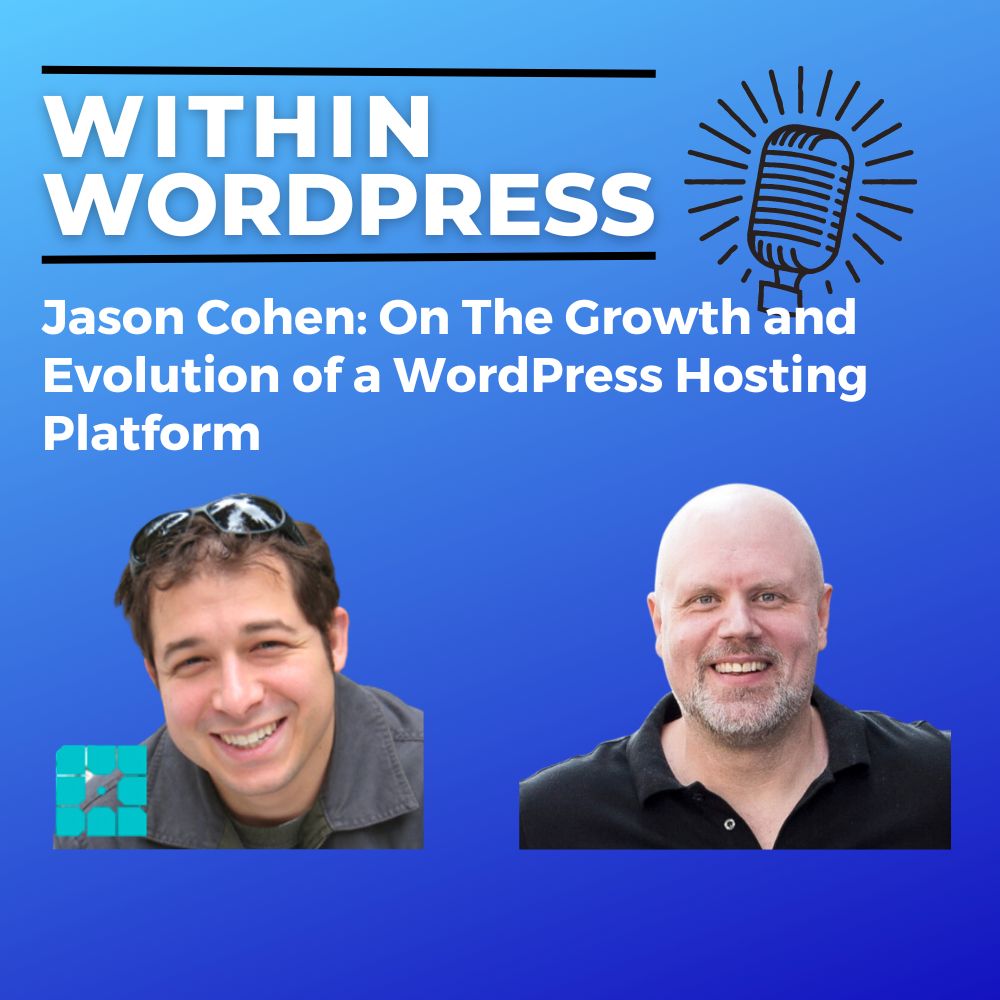
[00:00:00] Speaker A: Welcome to Within WordPress, the podcast about WordPress. What do you know?
With me today is someone who I spoke to not too long ago.
I received a demo because I was curious about a new.
I don't know if we even can call it a tool because I think it's a lot more than a tool. I think it's a whole way of solving a very big problem.
But all that to say. Welcome Jason,
[00:00:37] Speaker B: Thank you very much. Happy to be here.
[00:00:39] Speaker A: Yeah, well I'm happy to see you again because like I said, I had a curiosity.
I saw something and there was a demo which taught me a whole lot more and that made me even more curious. So let's start with, before we say what the demo was about, maybe you can share a little bit more about yourself first and then.
[00:01:02] Speaker B: Yeah, absolutely.
So from there, yeah, I'm Jason Conan, I go by JK because everywhere I go there's a lot of Jason's. I like to joke there's an Argos of Jason's.
[00:01:16] Speaker A: Yeah.
[00:01:16] Speaker B: In fact, my engineering counterpart I'll probably
[00:01:19] Speaker A: mention a few times, that's a good
[00:01:20] Speaker B: one, is a JSON. So just to distinguish me from other jsons, but I've been in tech oh well since the turn of the century and that's like a weird thing to sort of say, but I started life as a front end web developer back in the browser wars era. I was hand coding HTML and CSS and JavaScript and did the translation from table layouts to div layouts and all of those things and then sort of witnessed CMSs starting to come onto the scene, movable type, WordPress and others.
And as my career matured and got into some other things, I ended up gravitating towards product management. So I've been doing that for a number of years now.
[00:02:10] Speaker A: So from building software to product management, that's not a common route.
[00:02:14] Speaker B: No, but it served me really well because I've always been able to sort of speak both languages, the technical language and understand how things are put together, but also the value and the capabilities that the humans actually using the software need.
And so it served me very well having a view into both worlds over time.
But I was at a number of startups and some of those had really successful exits. Ended up at Microsoft for a while, which is very different than being at a startup.
[00:02:53] Speaker A: Oh, I believe that.
[00:02:55] Speaker B: And then my journey took me to getting connected with the tech scene in Austin, Texas and that ultimately led me to WP Engine, where then for about four and a half years I led our Headless offering, formerly called Atlas for a number of years, and now I'm leading our newsroom product line.
And product line again, I think to your point, isn't really the right way to talk about it. It's something more.
[00:03:28] Speaker A: It is.
So some of my clients are publishers, which is why I was curious, what is newsroom? When I saw.
What was it called? Couple of weeks ago, when I saw the news of the newsroom being introduced, I was curious, like, what is it? What kind of problems for the publisher world is it solving? Because like, again, like I said, again, I have a few clients who are nothing more than a, A publishing house, bunch of editors pumping out content.
People are constantly working, trying to.
There's probably about a dozen articles being pushed out every single day, and they've been doing that for 20 years. So as, as those teams grow, they run into all these weird types of, oh, but can we do this? Can we do that? And I've, you know, I have a system for them that works, but I also know it's never perfect. So I was super intrigued to go, hey, this sounds like it's right up my alley. Can you show me more? And you did.
And yeah, I think this is something more people need to be aware that it exists. So it's not a tool, I would say it's a suite. It's like a collection of things suite.
[00:04:50] Speaker B: I think early on when we were thinking about marketing, they suggested operating system as a good analogy. And I was kind of like, I don't think so.
[00:05:01] Speaker A: Yeah, it's a layer lower.
Yeah.
[00:05:03] Speaker B: But like, if you think about like a lot of different capabilities, you know, and the analogy with an operating system is there's a lot of capabilities there, but my workflow and what I need to do today within that is different than yours, which is different than another person's. Right?
[00:05:24] Speaker A: Yeah.
[00:05:25] Speaker B: And so from that standpoint, it is like kind of a similar concept. It's like it's a collection of things that all work interoperably together to solve different challenges and different workflows for, for, for people. And in particular, when working together, collaborating and generating a lot of content. Right. As we see in the publishing industry.
[00:05:49] Speaker A: Yeah.
[00:05:50] Speaker B: And, and so maybe it's not an exact analogy, but there is some similarity there, right?
[00:05:58] Speaker A: Yeah, I mean, I think so. Operating system, like you said, for me, that's a level below. But the, I don't know, when you demo this, there was quite a few, like, ah, that's neat. Like, that's actually solving a problem. And it's very Tempting to say, can you demo this now? So anybody watching the podcast can see, but the vast majority is listening, so we're not going to do that.
[00:06:31] Speaker B: Right.
[00:06:34] Speaker A: What would be the most important reason that you were triggered to go into, oh, this is a solution we need to solve.
[00:06:44] Speaker B: Right.
Well, I mean that goes right back into.
You're like, oh, how this solves a problem, that solves a real problem. And part of what has always interested me about software programming and things like that is software's supposed to solve problems. It's supposed to make things easier. Right. That's its goal. Right.
But like anything, it's not perfect and sometimes it gets in the way and it actually makes things harder. And as a, you know, like a product innovator, I look at that and like, well, these are, these are opportunities to make things better. Right. And so like the root of everything that I like to do and where I get, you know, my energy from is solving problems, like real tangible problems. Not me off with a whiteboard thinking just somebody has this problem, but like not really talking to people doing work.
[00:07:41] Speaker A: I, I saying, I recently spoke to somebody saying exactly that. Like not vibe coding myself out of a problem I invented myself. That's great, right?
[00:07:51] Speaker B: Yeah, well, you know, you know, there's things with like, well, necessity is the mother of all invention. And yeah, but, well, you have this problem, others do too. But that's not always true.
[00:08:03] Speaker A: No.
[00:08:04] Speaker B: And so talking to, knowing that there's a sizable amount of, you know, newsrooms, media businesses, publishing houses using WordPress. Because WordPress is a fantastic long form editorial tool.
[00:08:19] Speaker A: Yeah.
[00:08:20] Speaker B: And rightfully so.
But there's always going to be toil things that don't work, things that are hard to do.
And those are all it's like, well, what if we put some time and effort making that better? And that's really the, the genesis of any good product is what if we made something better?
What if we, what if we provided value, solved problems, made your lives easier so you can do your work because your work isn't, you know, as a, as a journalist, isn't managing the tech and dealing with all of the problems. No, no, no, it shouldn't be writing. Yeah, right.
[00:08:58] Speaker A: Yeah, yeah.
The thing that I found one of the most interesting approaches of. So if you are a publishing house, for those of you who don't have clients like this, or maybe you have a client that has a blog and they regularly blog, that is an entirely different world from an actual publishing house having anywhere from live covering to a multitude of editors working on the same piece, giving each other's feedback and processing it and then, and resulting into sometimes one, sometimes a series of articles. All of those sort of things bring in a level of complexity that unless you've actually worked with clients like that, it's kind of like, I don't, I get that it's complex, but I don't actually get it.
If you were to say like the size of the teams, what the solution when you were starting to hash out what it has to do, and I'd love to touch on a few features later, but yeah. What type of teams were you looking at? Were you specifically looking at the journalistic and high volume type or is it a large team? Did you have a spec specific group of journalists in mind?
[00:10:29] Speaker B: Yeah, it's sort of, you know, everybody has different definitions for these, like what's enterprise, what's mid market and so on. But like you sort of say, are you big enough where, you know, you're publishing several articles a day and you have several journalists working or more and you have people needing to collaborate and work together. That's very different, as you said, from like a blog where you have one person doing something and owning it all. As soon as you make that move into, there's a team or teams of people responsible for getting a product out because the content is the product in this industry.
[00:11:10] Speaker A: Yeah.
[00:11:10] Speaker B: I think we have to remember that is why do these businesses exist?
They exist to sell a product.
Their product is content.
Right. And the bigger they are, the more people involved. Just like anything, it gets complex. There's governance and approvals and different skill sets that come in. It's not one person doing everything. And so when you move into that realm, sort of the general purpose side of WordPress gets a little harder to work with. Right.
And we have, we had a longtime partnership with an agency out of the UK called Big Bite.
And I got to know them a couple years ago. They're one of their founders, Jason Agnew, another Jason.
And we just sort of hit it off on trying to solve problems and we found like kind of kindred spirit in how we approach the world and how we approach using technology to solve real problems and the care behind it.
And he and his team had deep experience with these very large enterprise newsrooms.
[00:12:21] Speaker A: Yeah.
[00:12:22] Speaker B: And as an agency they were constantly reinventing the wheel. Every project because it's project based. And you know, it's like, yeah, there was some stuff that could, you know, be reused and there was, you know, everybody's got their own tool bag of things to you do. But fundamentally it was rebuilding over and over and over again. And that's not a unique problem to them because I hear it from other agency partners and other developers.
And so Jason and I sort of said, well, what if we built software that sits on top, that is common, is meant to work together and solves a lot of the common challenges that people have in these larger businesses because we, we know what they are and you know, there's many of them and then, you know, there's so many, it's like, well, which ones do you tackle? Yep, right.
And then do that in a way that leans into the, the natural strengths of WordPress. Right.
And, and that is WordPress is this really extensible product platform.
Maybe that's the operating system that you can do anything with.
That's also daunting.
When you have a blank canvas and you're not an artist, what do you do?
How do you do this? Right.
And that's, it's like, well, what if we gave a really solid foundation and starting point for all the common problems that constantly get reinvented and then do it in a way where we can say, hey, we've solved this also, it's customizable and extensible so that we know and acknowledge every business works differently and has different needs. But if you have this common sort of technical language between all of the things to the user that really matters, the journalist, content editor, approver, the person working on SEO, whatever job they have, it all works together.
[00:14:36] Speaker A: Those are interesting. The ones that you just mentioned. Now if you've only worked with publishing teams where it's a handful of people, they're pretty much all of them do the same work. Right? They write it. Once they're done writing it, they maybe hand it off to somebody else to double check it for them. But they're the ones also doing the SEO part. They're doing the ones who are adding the images. That's generally the same person.
And the most complicated it gets is there's an editor in place who is doing the final set off.
That's about it.
What you demoed was, I mean, I really love that approach where all of the roles you just mentioned, they had their own interface into the content.
That was ultimately the published post. You should say, I should probably say, but it didn't feel like it. So can you explain me a little bit more about what if I am an SEO specialist and I get to work with Newsroom, what is different for me and the same for media and the same for editor? Because those three are super interesting.
[00:15:46] Speaker B: Yeah, well, it's looking at the different jobs to be done.
We have to produce an article, what are the jobs to be done? And smaller scale, you might wear all of the hats and do all of the jobs.
[00:15:58] Speaker A: Yeah.
[00:15:59] Speaker B: In the larger scale, there are people that have expertise and do those jobs separately. And sometimes there's a mixture of those things. But regardless if it's one person or if it's a bunch of people working, having a dedicated user experience to taking care of that job is really valuable. And rather than saying, this one interface, which is beautifully built for editing and layout, also should serve SEO and managing media and all of the other jobs to be done. And we say, well, no, actually it's not.
You know, that's why, you know, UX and designers and people exist, is to say, no, actually there, there are workflows that are better suited to different layouts, different designs, different ways of working, and you can increase efficiency by dealing with that and giving them the right experience for the job to be done. And so we broke those out into separate interfaces and we focused on those three to start to say like, these are probably the most common, important things that get done by different people in larger newsrooms. The journalist isn't always the SEO person and the person out there in the field taking photos and getting permissions and approvals for photos isn't the journalist.
And they, you know, like, there's different jobs. So give them a place where it's easy for them to work and then on top of that you solve a collaboration challenge. It's like, well, now they have a different place to work.
You can have those different jobs to be done. Being done simultaneously. Yeah, and you know, that's not just like Google, like collaboration, we can talk about that. But like, no, it's like there's a different person responsible for this. Give them the tools to do their job.
[00:17:57] Speaker A: I was going to ask about that because the collaboration part obviously is also an interesting one.
But yeah, the jobs to be done is a very interesting angle.
And one of my clients particularly has this problem they have.
It's male related content.
So it's very much focused on men coming up with stuff for men, which makes perfect sense. But they are hyper focused on generating that content and they literally have no other idea of what goes into publishing it. They're good at creating content.
And then when I started working with them about six years ago, one of the challenges we had is that they had zero interest in SEO and there were like probably eight, nine writers. They could in of those nine, there was no one who raised their hand when they asked who would like to have this role. They were like, no, no, let me just write, man, if I need to think about and optimize and this and this and that, I lose my creativity. I'm done, I'm out.
And at the time I was listening, I was going like, it's a little bit SEO. What's the problem here, buddy?
It can't be that hard. But it was.
[00:19:26] Speaker B: It is.
[00:19:27] Speaker A: And when you showed me, I was like, this had been perfect because they now have the editor, essentially the main editor do it.
And it's still not something he understands, he likes and he finds it confusing. And he constantly has to ask to take over the post and do this and do that. All these weird constructs they have the move to.
And your demo was like, man, where were you five years ago?
[00:19:55] Speaker B: Yeah, well, I mean, it's, it's sort of human nature. We each have our strengths and our interests and, you know, the stuff that we like doing. Right. And people that are writers, you know, and I'm generalizing because we all do a lot of things, but like, they, that's where they get their energy from, their value, what they like doing. And then you say, well, actually, because we're producing a product content, we have to do these other things that aren't writing to properly get a return on it. SEO, right?
And all that. It's like, well, now you put that on the writer who.
That's toil, what you described as toil.
And they're not maybe interested in it or they are not equipped or trained. They haven't built that muscle. And that's why in larger organizations there are people dedicated to that. And that's, that's true in building any product. If you're building an automobile, you know, the person that might be responsible for running the painting system on it is not the same person that's responsible for the exhaust system. Right. You wouldn't ask them to do the same thing.
[00:21:08] Speaker A: You know, it's funny you should say automobile because the, the, the client I refer to, they talk about cars and only cars in every, every single fashion and, and way you can think about.
But yeah, I mean, it makes sense, right? It's, it's.
If it's not your skill set or nor.
Or it doesn't give you energy in one way or not, you're not going to like it. But yeah, what news.
[00:21:35] Speaker B: You'll grudgingly do it if you're forced to.
[00:21:37] Speaker A: Yeah, but.
[00:21:38] Speaker B: And you'll ignore it if you're not forced.
[00:21:39] Speaker A: But. But the point I'm trying to make is that if it's in a system where it's one thing, you kind of are forced to do it. Or think of workflows that are just very, I don't know, kind of made up, like it needs to be done before 11. That gives me a little time to wait before all the systems lock you in, lock you out. Then I can introduce my thing. And then at the end of the day somebody says, you, yes, publish. Now, sure, you can schedule all that sort of stuff, but that is how they've been working around these constraints that.
And I've solved some of them.
For instance, I've used some of the Publish Press plugins that allow me to mandate certain things. Like you have to have a featured image there, you have to have tags, there may not be more than five tags and you have to have only, you know, you can force people to sort of checkbox their way to through content. But tell me a little bit more about how Newsroom is specifically designed to facilitate those types of workflows, because those are interesting.
[00:22:47] Speaker B: Like, yeah, well, you know, we can use SEO as a good example. And I've done a lot of different interviews where I hear, well, yeah, because of how things work. You know, we publish the article and then the SEO person comes in a couple days later and does SEO.
Like, well, that's, you're missing opportunity, you're missing possible conversions, things like that. And especially when timeliness matters, it's like, oh, well, because of how it works, or I can't get the journalist to do it, which was another customer. Like, no matter how much we mandate it, we can't get them to do it. Like, okay, well, the business losing sounds familiar, right?
But what we've done is said, okay, well these businesses are producing a product content.
And that product, the, the more mature they are, the more governance or rules or whatever they have that are needed to go do that. Right. And you know, for instance, a very large UK based newsroom used to have 30 hours of training on how to create an article to publish because they had no guardrails, no governance, no way to enforce a rule. Wow. And then as soon as we gave them ability to enforce a rule through a publication checklist, that training went down to one hour. Because it was practical and in the work, do the work and you see what you can and cannot do and then the tool guides you and helps you and that software making things easier. Now, a journalist might disagree with Me, oh, now I have to check out all these boxes to get a job done. That's where the other part of the tool can come in is say, all right, you must do these things before you publish. However, we're going to make it easy for you to actually accomplish that. And that's where things like recommendations, how to do things, AI suggestions and stuff can come into play.
So a really good example that we already have is, you know, thinking about accessibility and Web pages. There's a lot of things if you want to be wcag, you know, certified, and if, you know, government or, you know, a large organization, you're. You're really holding to that.
And I've talked to businesses where they do it after publication. They run a scam after publication, and then they spend all their time fixing these things.
[00:25:21] Speaker A: That's a couple of steps late.
[00:25:23] Speaker B: It's a couple of steps late. But, you know, take alt tags, for instance.
We put a block on the publication checklist saying, hey, this post has three images with no alt tags. You have to do that before you can publish. You cannot publish before it's done. But then we can also say, would you like us to generate these for you with AI and you. So you make it easy.
[00:25:49] Speaker A: Yeah.
[00:25:49] Speaker B: Right.
[00:25:50] Speaker A: I was going to ask, like, obviously, AI is overturning our world from every single direction.
How long ago did you start building this? Let's start there.
[00:26:05] Speaker B: Yeah.
Like, all of Newsroom. Yeah.
Yeah. So Newsroom was really created when Jason and I got together in December of 2023. Okay.
It started around then. And it. We had a lot of ideas, and we started building the actual building.
[00:26:26] Speaker A: Started end of 23. Yeah, yeah. So that. That's been a while. And that means you have seen AI go from, hey, this is interesting, to, holy crap, there's no way I cannot work without it because it's just omnipresent in all the different facets that IT use.
I'm imagining you had to pivot some of the features as you were building them just because of how fast AI was progressing.
[00:26:59] Speaker B: Less than you would think.
[00:27:01] Speaker A: Oh, interesting.
[00:27:03] Speaker B: And go back to, you know, talking about, we're solving a problem, there's a job to be done.
AI doesn't remove those jobs to be done.
We still need to do that.
What AI can do is make those jobs to be done easier or automated. Yeah, that's the difference. So you still have to have a way to do the job.
Right. But then you say, okay, how can we make it easier or automated? You know, in journalism, I would, you know, Say AI written content's not journalism. Right. And so I steer away from that. Yeah, but AI helping craft alt tags, that's a straightforward.
[00:27:44] Speaker A: I mean, yeah, that's straightforward.
[00:27:46] Speaker B: Or analyzing your data and saying, hey, you've used these imagery in a bunch of posts a lot lately, you should do something else, or making smart suggestions.
[00:27:58] Speaker A: That's the thing I was interested about, because that's the added value of AI. And I've said this before in previous episode of this podcast, I love AI in what it does.
But if we're thinking AI can solve the creativity part, the unique part, we've missed a plot. What AI does, it enhances whatever you throw at it, however you throw it, throw what you have at it. That is where the, to me, at least, the golden spot is of where AI absolutely shines.
And for anybody out there using the Yoast SEO Premium plugin, the AI integration where you generate the meta description, that's a perfect example, right? You've already written.
You've already written it, and all you're doing is giving the key focus, keyword, and then you hit enter, and then you have five options to choose from, five fingers, and you pick the one that is most suiting. That's.
That is the type of integration I think it should be.
Which is why when we're talking Newsroom as a full suite of solutions, there has to be AI, is my logic.
What would be the proudest thing you've built in there? Because I'm assuming the SEO and the alt tags, those are not the most.
[00:29:27] Speaker B: No, I mean, those are obvious things.
We're still working and we're still solving problems.
I think what we're working on next is where things get really interesting.
And so the analogy I use is we've been building a lot of Lego pieces and foundational work, and all of a sudden you can start combining these in new and interesting ways in ways inspired by customers talking. Oh, I see that. Well, what about this. What about this other thing? Right?
And you know what we're. What we're thinking about is if speed. Speed's important, quality is important.
With agentic search, sort of taking top of funnel away from your website, you know, you need to be cited and things like that. There's a lot of interesting things you can do to say, all right, you're still writing your journalistic content, we're going to do this work for you, but here's how it's interacting with agentic AI and agentic search. And, you know, here's how you make feed that into that, so that you get that attribute and you get that, that sighting and you ultimately get the customer coming back to your site lower down the funnel. You know, that, you know, right now, top of funnel got moved.
[00:30:51] Speaker A: That's the problem. Oh yeah, right.
[00:30:53] Speaker B: And, and, but they're, they're coming in with higher intent. And it's like, okay, they're higher intent, how can we give them higher quality? And it's not AI generated content, it's AI assisted to make that, make sure that it's really solid.
And I think for, for me, the best is yet to come with what we do with, with AI and some of our partners and some of our own capabilities.
I look at AI as, as those of us have been tech for a long time. We've seen these massive disruptions, what, every five years. Right. Like, yep, you know, first there was the web, then there was E commerce.
[00:31:36] Speaker A: Yep.
[00:31:37] Speaker B: That, you know, and then along comes social media and then comes mobile and then comes, you know, blockchain and web3 and now AI.
[00:31:47] Speaker A: Yeah, I skipped the one before, by the way. I skipped blockchain and web3.
[00:31:53] Speaker B: Yeah, well, yeah, I have feelings about those, I think. You know, but where we're at with AI is at the beginning of the cycle where it's a really interesting tool, but it's still looking forward to problems to solve.
And we're looking, we're trying to figure out how we as humans fit into that.
And that's the unknown. And the disruption is sort of what we're all feeling.
[00:32:17] Speaker A: I kind of feel that. And having said that, I'm getting a glimpse of where I think the direction is going.
And it's.
I think I've said this before as well, but it's essentially the AI is a large language model, which means language is nothing more than a bucket of data.
And the predictability of that bucket of data is where the model is really good at.
If you look at a website that has a lot of content and also meta fields and meta tags and all this metadata around the actual content.
But you could even argue that the object of the post has, with the blocks that we have already.
Meta.
Meta.
How would you call that?
It's meta sized already.
[00:33:16] Speaker B: Yeah, there's if, if you know, vertical is the product, it has components in it. Those components are blocks. Those components are the language.
[00:33:25] Speaker A: Exactly.
[00:33:26] Speaker B: Images, media, all that stuff. Yeah.
[00:33:28] Speaker A: So if, if that's all that we understand content to be and the relationship of that content to every other piece of content on that site, that is a tre. Treasure trove in Terms of the bucket of data that is at your disposal.
[00:33:47] Speaker B: Yeah, I know performance, you know, conversions,
[00:33:51] Speaker A: but you know, search as well and you know, search intent. And you, you have the, all of this, this whole bucket of data allows you to really start looking at what are those things that are just what I would normally do is I go to big query, I dump all the data in there, then I do my queries and then I find my results and inspirations and insights and all that sort of stuff. Then I bring that back. Now we don't need to do that anymore because we can do that on the main database. We have, let's for argument say, call it an MCP.
That allows me from the editor inside of WordPress to start thinking of the connecting layer to all the other facets that I know this site has as well. So the conversion, the funnels, the, the, the search, the, the, the predictability of what you're most likely wanting to see next. We can start measuring these at scale and with ease.
[00:34:56] Speaker B: That's what it's really good at.
[00:34:57] Speaker A: Well, and I, I think, I think we're starting to see this because I start seeing solutions that are less focused on AI doing AI things. But we're starting to like, okay, we can just continue to build the things on top of the things we're building and you know, AI continues to, to build AI. Great, wonderful. But I see a movement slowly going back to, all right, great that we can do that, but let's make this practical now.
[00:35:23] Speaker B: It's grounded in a real problem or job to be done.
[00:35:26] Speaker A: Exactly. And to me, newsroom, and if you say that there's a bright future ahead of the next features that are common with regards to AI, in my head, it has to be in this direction where you from predictability from the content writing perspective to the predictability of somebody reading and then the suggestions that come into that. And you know, there's, there's, there, you can say there's post, there's plugins for that, the related posts for WordPress Wonderful plugin and it is. But what if that plugin starts to really interact with the bulk of data that it has and just makes much smarter choices in presenting you the next version of content on that site and then push you towards a funnel, towards a goal like, wow. I mean it's a big monologue, but I just spew out, but I see these tools as you're building them and I go like, wow, what level of potential are we opening for large buckets of data that were just too cumbersome to comb through and build stuff for.
We don't need to do that complex thing anymore.
[00:36:40] Speaker B: We don't.
And that's where I think this thing shines.
And I sort of look at things, it's like, all right, identify the challenge or the problem or the job to be done.
Make it possible and easy, then make it informed, then make it semi automatic or automatic, depending on the problem.
Right. And that's a pattern that you can repeat.
So you and I can geek out over all the large data and all of that stuff. But put yourself in the shoes of somebody waking up in the morning and they're a journalist and how many decisions did they have to make? How much data do they have to look at? What do they have to do to decide what to write today?
[00:37:29] Speaker A: Yep, yep.
[00:37:31] Speaker B: Yeah, it's right.
[00:37:32] Speaker A: It's all of this, it's all, it's
[00:37:34] Speaker B: all of these things interconnected, but then it's grounded in a. If, if you could give somebody, hey, we've looked at everything that's going on. We've looked at data out on the web, we've looked at data in your site, we've looked at what's trending, we've looked at the types of things that you author and are good at and what converts. Here's some paths that you might want to explore today.
[00:37:59] Speaker A: You're hinting at one of the questions that I had, which we haven't talked about this before we started recording, but I don't know if you use Grok as an AI, it's part of X or sort of.
In Grok, there's specifically an interface that allows you to create tasks and those tasks are nothing more than a prompt that you give it. So what I've done is I have a prompt for my name, I have a prompt for scanfully, I have a prompt for within WordPress, I have a prompt for WordPress news. And it's not just tell me the latest WordPress news, but it's very specifically highlighting how I want it to scan for me and produce information related to the actual full prompt. And what that does it gives me. Every morning I receive an email in that or in the app, whatever, and it has produced what I asked it to do.
My question to you was going to be, how easy will it be to turn that output of any monitoring system I have into. And here's me feeding you into the.
The topics to cover for this day. But you beat me to it. That's essentially what you said is, is. Is, you know, is lined up to
[00:39:21] Speaker B: Happen right in people. You know, kind of going back to my blank canvas analogy, you know, it's like, here's your starting point, here's the suggestion, here's what you know and the data behind it.
And then maybe you have one of those first thing in the morning meetings as a team and you're like, we should write about this, we should write about that. We should write about this. And you could now come to the table armed with more information and suggestions that are higher quality.
And then let's say you're a cyclical business and you're writing a lot of content, but it's cyclical in nature. You know, it could be like, cool. Well, we're entering March and now these are the topics that typically trend around now and have higher conversion rates on whatever you're trying to do.
[00:40:11] Speaker A: Exactly.
[00:40:11] Speaker B: Here you go.
[00:40:12] Speaker A: And, and this is what you wrote about last year and you touched the topic not in, in. In main article topic, but the, the, the. This particular topic you also touched in other articles sort of referencing as it a backstory and all.
It just feeds into. I mean that to me is the part of AI that truly excites me because it just makes all of these things so incredibly.
I know it becomes alive. So to say I'm running a custom GPT.
Well, I was running a custom GPT of every single newsletter that I've published, my within WordPress newsletter. And I had.
I have had.
I'm moving to a new system.
Every single podcast that I've done has been transcribed and also uploaded. So if I think I've covered something, I just ask and it'll tell me what I have and who I have mentioned and what I have linked to and all that sort of stuff.
And to play with that type of.
You covered this already. Let me be super in context here or let me reference this or understand who I've been speaking to about. If I wanted to, I could. Because, you know, for the last 1520 podcast recordings, there's been some elements of AI that I've covered. If I wanted to summarize all of my opinions and experience about AI, I can just do that. That's just super simple. And then I write my article around that, like all that sort of stuff. It just gets me really excited about the. And because we're just scratching the surface here, we're. We're just just starting to grasp what.
[00:41:57] Speaker B: We're figuring this thing out, right?
[00:41:58] Speaker A: We are figuring it out.
[00:42:00] Speaker B: Yeah. I sort of look at this like now's the time to innovate. Now's the time to experiment and see what works and see what's valuable, but do it fast. Don't spend a year off doing something like so.
[00:42:16] Speaker A: And this was.
[00:42:17] Speaker B: Innovate quick.
[00:42:18] Speaker A: Hey, Exactly. And this was my question when I asked you during the time that you started building this and now, because you've launched it, like a month ago or something.
Yeah, lots changed. Exactly. The role of AI, and particularly its capabilities, have vastly improved.
And for the large portion of people, they're just looking at the generative side. So produce me code, help me with an outline for an article. Double check. If I'm covering all angles, am I introducing any fallacies, that sort of stuff, you know, you. You can just.
Most people just use it for that. And I go, ah, but that's.
[00:43:01] Speaker B: You're missing. You're missing the value.
[00:43:03] Speaker A: It's not even scratching the surface. It's just.
[00:43:05] Speaker B: Now I. I look at it, I think somebody said, I always wondered what Ark would be if it had no soul. And that's the generative imagery and things like that. It's fun. It helps people that might not have the capability to create that on their own or don't have the time or inclination to do it, but we all look at it and say, there's no soul here. The same thing's true with content.
[00:43:33] Speaker A: Yeah.
I tell you what. I think I have created five images generated by AI in my lifetime. I have zero interest in it. I just. I just. It's just not.
Doesn't.
I don't know. Just not.
[00:43:48] Speaker B: I'll tell. I'll tell you how I used it.
I use it as. I'm trying to get something out or explain something quickly, and I'm not in a position to whiteboard it because I love whiteboarding, you know, and it's like, I'm a very visual person and I communicate visually.
And a friend of mine and I wanted to get a tattoo to commemorate a climbing of Mount Fuji. And we had this idea, and we were trying to, like, how do we explain this to the tattoo artist?
So we had AI generate it and we said, look, we don't want this. Exactly. But this is the theme,
[00:44:31] Speaker A: I guess. I mean, first of all, that's a cool idea for a tattoo.
And second of all, that's a very interesting approach of using generative AI, which I can totally get behind.
I think it was more referencing the.
The featured images you see, and the stuff that they.
[00:44:50] Speaker B: Yeah, those. Like, we all look at them, something's off.
[00:44:53] Speaker A: Yeah. I go, like, why? Just. Just don't like, yeah, something.
[00:44:57] Speaker B: Something's off.
[00:44:58] Speaker A: There's so much I prefer. You have a colored gradient background. Oh, sorry, yeah. Color gradient background with the text on top of it. And just have Canva create something for you. Just do that, please, because it's just better.
[00:45:10] Speaker B: Yeah. And I think, you know, those of us in tech kind of can sniff out, oh, this presentation, all the imagery is made with AI because it's like weirdly intricate and super detailed. And it's missing, missing that thing.
[00:45:27] Speaker A: On that note, by the way, there is. I mean, it is generative. I don't.
There's a tool out there, AI powered, obviously. It's called Napkin AI.
You throw any complex model of whatever it is you find difficult to describe, and you throw it at it.
It'll give you, like, four different ways to represent it.
You pick the one you like the most. You can. Can alter it, you can change. You can change colors, sizes and all that.
That's probably the only tool that I use in that context because it's. It just makes it easier to have if I need to explain a DNS setup. Like, how do I visualize that? I mean, I know what it looks like in, in the physical hardware, but how do I visualize that? I can sort of figure it out, but that's going to take a little time to create.
I threw it in there and they go, oh, that's. That's what I mean. I like that.
[00:46:28] Speaker B: Yeah, well, you use that to assist in communication.
[00:46:32] Speaker A: Yeah, right, yeah, but it's not my main communication.
[00:46:35] Speaker B: No, no, right, yeah. And so that. That is.
I think there's these reasonable uses, but, you know, I think that that's a reasonable use. I think, you know, using it to. To generate small things or make suggestions or improve things, that's a really good use of it. Or look at large data sets that it just is time consuming for a human to go do. It liberates and democratizes some of the data and the capabilities and things like that. But then there's also a sense of, okay, right now it's sort of the Wild west analogy. This isn't all over the place. It's everywhere and everywhere you turn. And all of this stuff.
How do we say, actually, this is a good use of it, this other thing is not.
And I think that's something that will come out as tools and capabilities to really help people with their problems emerge. Right now I have older family members that are like, look at this thing. I made this picture. It's really funny. And they're passing it around that's all AI is to them.
[00:47:46] Speaker A: Yeah, yeah, yeah.
If it's interesting, it's very interesting. But I think we're.
What was it two weeks ago? I saw somebody was.
Somebody had posted like a hundred dots representing 100% of the world population. And then one or two dots were colored and those two colored. I think it was two. Those two colored dots represented the amount of the percentage of people working with AI and understanding it.
And then there was a few more dots that people have touched AI in some way, fashion.
And then the rest was just like 95 dots were just empty.
[00:48:32] Speaker B: Like.
[00:48:32] Speaker A: We're just getting started. We're just getting started.
[00:48:37] Speaker B: Think back to when Google appeared and was, I remember, game changing for search. Yeah, but how many years did you essentially answer questions by Let me Google that for you?
[00:48:50] Speaker A: Because they hadn't figured out there was a website.
[00:48:54] Speaker B: There was a whole website about that.
[00:48:56] Speaker A: Lm. Yeah, let me Google that for you. Whatever the abbreviation is.
And you typed it in and then it was an animated version of the search.
Doing that.
[00:49:06] Speaker B: Right. It's sort of the same thing. It's like we're, you know, we have a bunch of us that are early adopters and we're trying to figure this thing out and there'll be a long tail of people figuring it out, building on it, adapting it, understanding its value.
And still not everybody's going to use it. No, but it'll be a part of their lives, you know.
[00:49:28] Speaker A: Well, I think, I think, like I said, I think we're at where the pivoting point point is here or is about to be here.
And I think for, for certainly for media and, and content teams. I mean, now really is the time to really, really rethink your publishing strategy and think about what kind of tools am I using? Am I still being the smartest person in the room here? The way I'm doing this currently? Because a lot of these solutions are cobbled together. Right.
[00:50:01] Speaker B: They're very coupled together.
[00:50:02] Speaker A: Yeah. And I mean, fragmented is a good
[00:50:06] Speaker B: way of thinking about it.
[00:50:08] Speaker A: There you go. I was going to ask you to give a few features because we touched on some features already.
What would you say, like the.
Is it a top five that you could mention? How do.
I'd like you to share a little bit more about the features that are part of Newsroom that we haven't touched. Because there's a lot more. I'm just, you know, it's a too large of a tool to fully demo out in 15, probably not even in 30 minutes.
[00:50:39] Speaker B: But if I Do if I, if I bore somebody with every single feature, it's over an hour.
[00:50:44] Speaker A: Is it really? Yeah.
[00:50:45] Speaker B: Okay. Yeah.
To properly do it. But you know, that's not a good demo, like, but, you know, it's sort of the highlights and we've mentioned a couple of them.
Putting governance in with publication checklists and things like, that's really important.
You have to be able to control the quality of the product that you're putting out there. Right.
So that's one. The separate workflows for different jobs to be done is another one that's, that's pretty important.
But then it comes down into, you know, how are people collaborating together?
How, you know, how are they working together? The number of companies that I've talked to where, oh yeah, we work in Worm or we work in Google Docs and then we copy and paste and put it over here. And we don't actually use the very excellent editorial tool in the block editor. Yeah, they don't really use it and I think that's a shame.
And I was demoing somebody and it's like, what would it take for you to stop using Word to draft your content? And then I showed them comments, I showed them collaboration, I showed them the workflows, I showed them publication checklist, I showed them visual revisions and they're like, oh, it's here.
That was what they needed.
[00:52:06] Speaker A: That's funny, you mentioned the collaborative mode, which is interesting because I think you're ahead of what WordPress is intended to add. I think first element is, is, is landing in 7.0, I, I believe.
[00:52:22] Speaker B: Yep. Yeah. Yeah. Beta 3 just dropped and they're, you know, I think it's on, on by default in there. And yeah, it's exciting for WordPress as a whole, as a whole community, because I think everybody's wanted something like this for a long time.
[00:52:37] Speaker A: I, I, I have limited, very limited requests from it from clients, even though I worked with quite a few publishing titles.
[00:52:46] Speaker B: But I think it depends on the industry and the user.
[00:52:50] Speaker A: Yeah, possibly. But you've built something separate from that or ahead of that. How do I see that?
[00:52:56] Speaker B: Yeah, so we've built something ahead of that and our sort of philosophy on that is, know, embrace Core. Right. So that there's not these, well, these things don't work together, they're incompatibilities. But what we do is say we're looking at a particular vertical that Core might not be able to do. Yeah, because Core has to look very wide. They have to consider.
[00:53:20] Speaker A: Exactly. So it's, it's the lean.
It's the lean and mean that core provides.
[00:53:24] Speaker B: And then, and then, and then what does this industry.
[00:53:29] Speaker A: Y.
[00:53:30] Speaker B: Right.
And you know, our experience with these newsrooms is not every article actually needs Google. Like collaboration, actually, that sometimes gets in the way.
[00:53:40] Speaker A: Yeah, yeah.
[00:53:42] Speaker B: So do you need it when. Oh, it's all hands on deck. This is really fast. We got a bunch of journalists trying to work on it together. Cool. Turn it on and do the thing. Get the thing out. Respondents Feed and collaboration. But, like, daily workflow doesn't always call for that. I don't know if you've been in a Google Doc when 20 people are typing.
[00:54:04] Speaker A: It's a menace.
That's not for me.
Let me go in when everybody's done, and then I'll do my thing.
[00:54:12] Speaker B: But not use it when you need it.
But a lot of the workflows are just separating out those jobs to be done and letting the different people work at the same time solves a lot of problems.
It's because everything was jammed into one thing that it's like, well, collaborative editing is nice and it shows well and it's exciting, but you have to think, what situations do I need that versus other ways to approach a problem?
[00:54:41] Speaker A: Yeah, yeah, I like that. I like that. I like that you're ahead of the curve and already thinking on.
I mean, the bottom line is WordPress is built for this. Right. It provides a particular solution, and you are to amend that solution to your particular need.
I like that you have it already in there.
[00:55:04] Speaker B: We'll make sure it scales and is seamless. And that's our job. Right. And that also speaks to the fragmentation.
These things that we're building as we say, hey, this is. This is meant to be maintained and grown and adapted as we all learn together and technology marches forward and we have this opportunity to not have this fragmented experience.
And I was very purposeful. When I say it's meant to be customized and extended, it's not. You must do things this way because people work differently. But it's putting enough structure around it that when you're not just a blogger, when you're a team of people, when you're a business and you need to rely on content as your income, as a business, you have enough structure to actually organize the way you need to.
[00:55:58] Speaker A: Yeah.
I think it's a brilliant, innovative way to handle a newsroom. A good title.
There's. Yeah.
For anybody listening wanting to get the same demo I got. How do they go about that, Jason?
[00:56:18] Speaker B: Yeah.
So can go to wpengine.com and we have a whole section on newsroom there can get in contact with us.
Yeah, we have going to try to understand a little bit about your business and where do you have to fail, where do you have problems, where do you have friction, where do you have things that are costly for you to maintain? And then we can say cool. Once we know that, we can take that hour long demo of all the features and focus in on what really matters to you. Right?
[00:56:51] Speaker A: Yeah.
So having seen the demo, having seen what you guys build, I think for me highly recommended anybody working with news teams to check it out. It's a wonderful solution.
And I want to thank you again for well, repeating some of the things we talked about in the demo. But thank you for coming on, Jason. Appreciate it.
[00:57:17] Speaker B: Well, thank you for having me. It's been been a fun conversation and I'm happy to talk about this all day long to anybody who listens.
[00:57:23] Speaker A: Well, like I said, when I start recording, I'll tell everybody the conversation is meant to be somewhere between 4, 45 and 60 minutes. And sometimes it's you, you kind of have to force yourself to cut it off at 60.
I think we, I think there's a lot of different cover different angles. We could still cover it. Also, you know, it stems from me having worked with quite a few newsrooms, published publication titles that I understand the problems that I go that, you know, my light belt went on like, oh, that is cool. That is cool. Oh, that's also cool.
So yeah, thanks again for sharing. Appreciate it. Yeah, thank you.
Until the next time, thanks.